
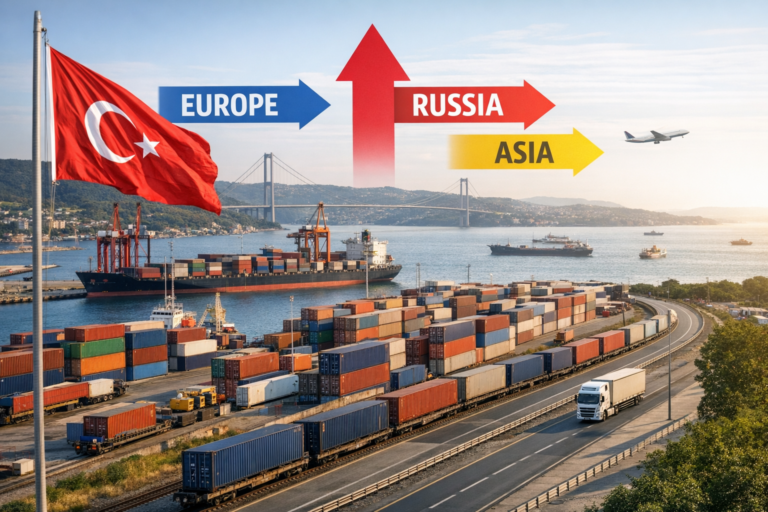
Turkey as a Europe-Russia-Asia Route Hub
Update as of January 2026
1) Turkey-Europe vs Turkey-Russia: comparing tariff logic and transport conditions
An important note on “tariffs”: open sources rarely publish a single unified price. In reality, pricing is shaped by surcharges, insurance terms, transit times, cargo restrictions, and compliance requirements. For that reason, the comparison below focuses on the cost structure and risk profile, rather than on a simplified “€X per truck” figure that may later prove misleading to clients.
Turkey to Europe (EU / Europe)
What usually makes this route more predictable:
More standardized documentary requirements, procedures, and infrastructure.
However, the route remains sensitive to demand conditions in the EU, seasonality, and bottlenecks at ports and border crossings.
Maritime leg through the Mediterranean
In 2023-2024, freight rates experienced major fluctuations because of disruptions in shipping through the Red Sea and the Suez corridor. These disruptions also affected Mediterranean-linked routes, including higher rates on Far East-Mediterranean services and longer transport distances caused by rerouting. UNCTAD reports that in 2024, growth in seaborne trade measured in ton-miles significantly exceeded the growth in physical cargo volumes, largely because vessels were sailing longer routes. This directly affects freight rates, schedules, and fleet availability.
Turkey to Russia
What more often makes this route more expensive and administratively complex:
A higher role for compliance, including banking, payments, insurance conditions, counterparty screening, and checks on the origin and destination of goods.
A greater likelihood of uneven transit predictability because of regulatory reviews and intermediary chains.
Why this matters now:
The OECD notes that Russia’s full-scale invasion of Ukraine and the ensuing sanctions greatly complicated overland freight transport between Europe and China via the Northern Corridor, while attention has shifted toward the Trans-Caspian Middle Corridor. Eurostat also shows that EU-Russia trade remains structurally altered, with EU exports to Russia down by 61% and imports down by 90% between Q1 2022 and Q4 2025. This broader sanctions environment continues to reshape transport geography and the cost of risk.
2) Freight flow outlook: Black Sea and Mediterranean regions
Mediterranean region, including Turkish ports
The main driver in recent years has been the reconfiguration of routes due to risks in the Red Sea and around the Suez Canal, which has pushed up sailing distances, costs, and schedule volatility. UNCTAD describes this effect in detail, linking rerouting to longer voyages and unstable freight pricing. UNCTAD’s 2025 maritime outlook projects a slowdown in seaborne trade growth in 2025, after 2.2% growth in 2024, with medium-term annual average growth of around 2% expected for 2026-2030, but within a more turbulent geoeconomic environment.
Black Sea
The core risk factor remains the same: the war, restrictions affecting navigation and insurance conditions, and the redistribution of flows, including grain and energy cargoes, through alternative routes. UNCTAD has linked the simultaneous disruptions in the Red Sea and the Black Sea to wider risks of trade-map reconfiguration and higher logistics costs.
3) The impact of sanctions and trade restrictions on routes
What changes in practice, without political slogans:
Insurance and financing increasingly become part of the logistics price, and sometimes the decisive part.
The importance of a “clean” supply chain increases, meaning the counterparty, origin, destination, and product category matter more for both transit time and route selection.
As a result, companies more often choose routes with lower regulatory risk, even if those routes are longer.
What available data confirms:
OECD analysis shows that sanctions and the war have complicated the Northern Corridor and increased interest in the Middle Corridor as an alternative. Eurostat data confirms that EU-Russia trade flows have changed substantially and remain far below pre-war levels.
4) Turkey’s role as a transit hub between Asia and Europe
Turkey is strengthening its role as a route-switching hub for three main reasons:
Geography and infrastructure: the link between the Black Sea and the Mediterranean, with access to the Caucasus and Central Asian corridors.
The Middle Corridor: the Trans-Caspian / Middle Corridor is receiving more attention as an alternative to routes through Russia. OECD analysis says the corridor gained renewed attention after 2022 because the Northern Corridor was disrupted by the war and sanctions.
Connectivity investments: projects to improve railway connectivity in eastern Türkiye along the Divriği-Kars-Georgia border section of the Middle Corridor are described in World Bank project documents.
What this means for the market in practical terms
Turkey is becoming not only an export-import country, but also a route country for transit traffic. This increases the importance of:
digital services, including visibility and tracking,
capacity at key nodes such as ports, rail links, and borders,
and resilience to route shocks through the ability to redirect flows.
These priorities are also consistent with OECD recommendations on digitalisation, border procedures, customs capacity, and logistics efficiency along the Middle Corridor.
5) A short “numbers for credibility” block
According to TİM, Türkiye’s exports reached $273.4 billion in 2025, up 4.5% year on year, marking a new record.
TÜİK continues to publish regular foreign trade statistics with monthly and cumulative indicators, which makes it a useful source for “markets today” updates in a logistics blog or industry digest.
UNCTAD’s Review of Maritime Transport 2025 reports growth in maritime trade in 2024, a projected slowdown in 2025, and medium-term expectations for 2026-2030 shaped by ongoing geoeconomic restructuring.
Sources
UNCTAD Review of Maritime Transport 2025 (Overview, PDF)
https://unctad.org/system/files/official-document/rmt2025overview_en.pdf
UNCTAD Review of Maritime Transport 2025 (Chapter 3, PDF)
https://unctad.org/system/files/official-document/rmt2025ch3_en.pdf
UNCTAD rapid assessment (Red Sea / Black Sea / Panama, PDF)
https://unctad.org/system/files/official-document/osginf2024d2_en.pdf
OECD/ITF – Transport System Resilience (Summary and Conclusions, PDF)
https://www.oecd.org/content/dam/oecd/en/publications/reports/2024/05/transport-system-resilience_f51c36d9/d90b86ac-en.pdf
TİM – Türkiye set a new export record in 2025 with $273.4 billion
https://tim.org.tr/en/turkiye-set-a-new-export-record-in-2025-with-2734-billion
TÜİK – Foreign Trade Statistics (пример: October 2025)
https://data.tuik.gov.tr/Bulten/Index?dil=2&p=Foreign-Trade-Statistics-October-2025-53907
OECD – Trans-Caspian Transport Corridor (state of play, 2025)
https://www.oecd.org/en/publications/enhancing-the-competitiveness-of-the-trans-caspian-transport-corridor-in-central-asia_f261e7fa-en/full-report/tctc-state-of-play-challenges-and-policy-considerations_b8a252b7.html
World Bank – Eastern Türkiye Middle Corridor Railway Development Project (PDO document, PDF)
https://documents1.worldbank.org/curated/en/099092225112539558/pdf/P179128-d635001f-374a-4ba0-b11f-0f1c1f6929d7.pdf
Eurostat – EU trade with Russia (latest developments, PDF)

