
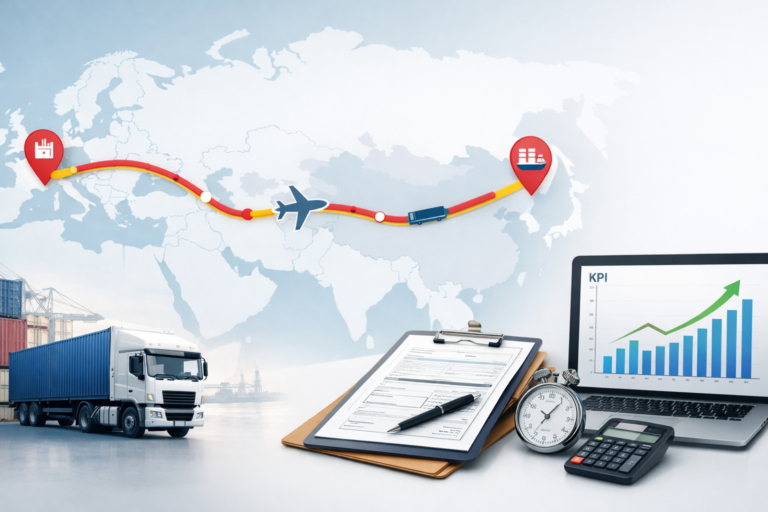
Practice No. 1. FTL vs LTL in Europe: What to Choose to Avoid Overpaying and Missing Deadlines
SEO Title: FTL vs LTL in Europe: Which Is More Cost-Effective and Reliable
Meta Description: The difference between FTL and LTL in the EU: transit times, risks, surcharges, when to book a full truck, and when groupage makes sense. A practical selection checklist.
What FTL and LTL Mean, Without the Textbook Tone
FTL (Full Truck Load): a full truck dedicated to one client. Faster, simpler, and with fewer points where things can go wrong.
LTL (Less Than Truck Load): consolidated cargo. Cheaper on paper, but it involves more handling operations and more potential delays.
When FTL Is Almost Always the Better Option
The timeline is critical, for example when delays mean penalties, missed sales launches, or production downtime.
The cargo is fragile or high-value. Fewer reloads usually mean fewer damage risks.
The shipment volume is already filling a substantial part of the truck, so the savings from LTL start to disappear.
You need tighter control. GPS tracking, ETA management, and accountability are usually easier with FTL.
When LTL Is Actually More выгодный
The shipment volume is small and there are no hard deadlines.
You have regular small shipments and can build a stable consolidation schedule.
The cargo value is relatively low, so occasional delay risk does not destroy the economics of the deal.
The Main Trap of LTL: “Cheap” Does Not Always Mean “Cheaper”
In LTL, additional costs often appear later:
warehouse waiting time,
extra handling and reloads,
unexpected sorting or relabeling,
paid re-delivery,
delays caused by incorrect documents or mismatch in pieces, dimensions, or weight.
One-Minute Decision Checklist
Choose FTL if:
time matters more than price,
the cargo is valuable or fragile,
there are delay penalties,
you need as few risk points as possible.
Choose LTL if:
deadlines are flexible,
the shipment is small,
shipments are regular,
you are ready for consolidation and hub control.
Practice No. 2. Demurrage and Detention: Why the “Invoice from Hell” Happens and How Not to Overpay
SEO Title: Demurrage and Detention in Logistics: How to Avoid Penalties
Meta Description: A simple explanation of demurrage and detention. Why penalties happen, the most common mistakes, and a practical checklist to avoid unnecessary costs.
In Simple Terms
Demurrage: a charge for leaving the container at the port or terminal longer than the free time allowed.
Detention: a charge for keeping the container outside the port gates longer than permitted.
Both charges usually begin where people “simply ran out of time.”
Top 5 Reasons Why Penalties Appear
Documents are not ready before vessel arrival: invoice, packing list, bill of lading, certificates.
Customs inspection or control was not factored into the timeline.
No truck was booked for pickup: lack of capacity, poor planning, or peak season pressure.
The warehouse cannot receive the cargo: no slot, no staff, no space.
Errors in shipment data: weight, number of packages, codes, consignee, address, contact details.
What Should Be Agreed in Advance and Why It Matters
Free days for demurrage and detention, and how a “day” is defined, whether calendar day or working day.
Who pays if the delay is caused by the client’s documents.
SLA for document submission, for example: “not later than X days before ETA.”
Practical Anti-Penalty Checklist
7 to 10 days before ETA: documents finalized and checked against a checklist.
3 to 5 days before ETA: pickup transport confirmed, warehouse slot booked.
On arrival day: release monitoring in place and a ready Plan B, such as another truck, another warehouse, or temporary storage.
Case 1. How We Reduced Loading Delays in Europe by 35%
A Realistic Scenario
SEO Title: Case Study: Reducing Warehouse Waiting Time by 35%
Meta Description: A practical case study showing why trucks were waiting, what changes were introduced, and how SLA stability improved.
Context
Regular road transport within the EU. The problem was simple and expensive at the same time: trucks were waiting 6 to 12 hours for loading.
The Problem
there were no proper time slots,
the warehouse worked in an unstructured way,
the driver arrived, waited, got exhausted, and then missed the delivery plan.
What We Did, Without Any “Magic”
Introduced time slots and the rule: no slot, no arrival.
Agreed warehouse KPIs: average loading time and percentage of trucks loaded on time.
Added buffer windows on peak days.
Introduced penalties and bonuses, not to punish, but to create discipline.
Started tracking the facts: arrival time, loading start, loading end.
The Result
average waiting time dropped by about 35%,
ETA became easier to forecast,
there were fewer driver-related conflicts and fewer urgent replacement costs.
Conclusion
Sometimes you do not need to “optimize logistics.” You just need the process to work by rules instead of mood.
Case 2. Saving the Deadline Without Sending Costs Into Orbit
Partial Air, Partial Sea
SEO Title: Case Study: A Combined Air + Sea Model to Avoid Losing the Contract
Meta Description: When air freight is worth it. How to ship the urgent part by air and the rest by sea without blowing up the budget.
Context
A shipment from Asia to Europe. The client needed the goods “yesterday,” otherwise there would be penalties and lost shelf space or even the contract itself.
The Problem
Full air freight was too expensive. Full sea freight was too late.
The Solution
The shipment was split into two parts:
the critical minimum, meaning the SKUs needed to launch sales, was shipped by air,
the rest was sent by sea under the standard scheme.
We agreed with the client on the true “minimum for launch” and a transparent timeline for the remaining cargo.
The Result
the contract was not lost,
the budget stayed under control,
the client got a working launch instead of “everything at once, but too late.”
Conclusion
In logistics, the winners are not always the ones who are “the cheapest.” They are the ones who know how to split the problem into workable parts.

