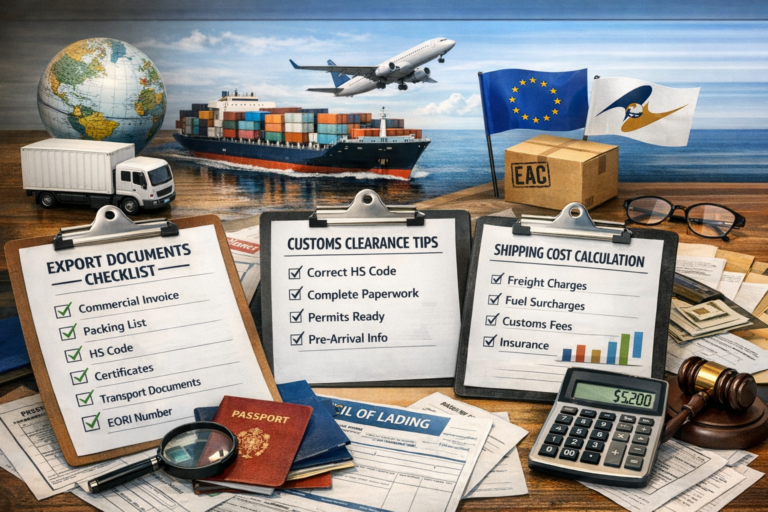
Contract / invoice (Commercial Invoice): who sells to whom, what goods, at what price, currency, delivery terms.
Packing List: packages, gross/net weight, volume, markings, consistency with the invoice.
HS code / TN VED code preferably already checked by a customs broker: duties, restrictions and documents depend on it.
Transport documents: CMR / bill of lading / air waybill, etc.
Country of origin and proof of origin if a tariff preference is required or upon request.
Permits and regulatory documents if the goods are “controlled”: licenses, sanitary/phytosanitary certificates, etc.
EORI: without it, any customs operations in the EU turn into a quest with a bad ending.
Security / advance data (ICS2 / ENS): for shipments to the EU or through the EU, data is submitted in advance, and the requirements have been expanded to different modes of transport; current guides and updates are published by the European Commission.
The Customs Code of the EAEU and national rules of the member states provide guidance on requirements.
A common “trap” for beginners: EAEU TR / EAC declarations/certificates of conformity for goods that fall under technical regulations.
If at least one of the three does not match in the documents: name / quantity / weight, customs starts to “love” your shipment especially gently and for a long time.
The cost of transportation is almost never equal to “the rate for a truck/container”. A normal calculation looks like a constructor:
freight / transport rate, FTL/LTL, container, air, rail
route and legs, delivery to port/terminal, last mile
fuel surcharge, toll roads, ferries, downtime, waiting time
terminal handling charges, THC, handling, warehouse/transshipment
demurrage/detention, for containers
cargo insurance
customs broker services
duties/taxes, where applicable
certification/permits, if the goods are regulated
Incoterms define who pays for what and at which point the risk transfers. A mistake here turns a “profitable deal” into charity.
Ask the carrier/freight forwarder for a calculation in two columns: “included” and “not included”. If this is missing, surprises are already on their way to you.
The fastest way to speed up customs: do not force customs to ask questions.
The TN VED / HS code is confirmed in advance, not “well, it is roughly the same type of product”.
Consistent terminology in the invoice / packing list / CMR, the same product name, without creativity.
Correct customs value: price logic, supporting documents if necessary.
Permits are ready before shipment, not “we will bring them later”.
Advance data submission where required, especially relevant for shipments to the EU due to security / pre-notification requirements.
invoice + packing list
contract/specification
plain-language product description: composition / purpose / material / model / photo, if helpful
HS code, if available, and country of origin
permits, if applicable
sender/consignee details and contact person
EXW / FOB / CIF / DDP without understanding who pays and who bears the risk.
And then comes the surprise: why “they do not release it”.
This almost always means either delay, recalculation, or penalties.
One thing in the invoice, another in the packing list, a third in the CMR. Customs collects this kind of thing.
The product may be excellent, but without EAC / EAEU TR it becomes “cannot be released”.
Especially for “sensitive” categories: chemicals, equipment, food products, medical devices, etc. The EAEU rules separately establish the principle of compliance with prohibitions/restrictions when moving goods across the border of the Union.
European Commission, TAXUD: EORI, ICS2 / ENS and guides
https://taxation-customs.ec.europa.eu/customs/customs-procedures-import-and-export/customs-operations/economic-operators-registration-and-identification-number-eori_en
https://taxation-customs.ec.europa.eu/customs/customs-security/import-control-system-2_en
ICC, Incoterms 2020: rules and logic of risk / place of delivery
https://iccwbo.org/business-solutions/incoterms-rules/incoterms-2020
Customs Code of the EAEU, official text
https://eec.eaeunion.org/upload/medialibrary/9dd/Customs-Code-of-the-EAEU.pdf
General overview of declaration/document submission procedure under the EAEU
https://www.sorainen.com/publications/customs-code-of-the-eurasian-economic-union-2
EAEU TR / declarations of conformity, as a type of required document for import/circulation
https://www.ifcg.kz/en/services/docs/tr/declaration-tr-eac